I began to realize this summer as I had a chance to read some non-fiction books I had never had a chance to read before, that I tend to just accept things that I hear preached or that I read from well-known Christian leaders.
 Even though I’ve been told to test things against Scripture, I was lazy. And that’s a dangerous thing to be when it comes to understanding Scripture.
One of the things I didn’t realize was what the word “ezer” really means. In many versions of the Bible it’s translated “helper.” I accepted that. Women are meant to be helpers to men.
Then, I read those books. The Blue Parakeet, The Resignation of Eve, and Half the Church.
Oh, my.
Did you know that “ezer” actually should be translated “power” and “strength”?
Wow. That’s a bit different than the “helper” I’ve been taught to believe.
“Ezer Kenegdo” are the words used in Genesis. According to many scholars, it should more accurately be translated “warrior,” “one who comes to save you.” It was a name used for God.
I am not a biblical scholar. I know I have a lot to learn. But this is big.
There’s a ton being said these days about inappropriate actions of men toward women.  We have seen many men of power taken down by the testimony of women with whom they acted inappropriately.
I’m thinking it quite possibly has to do with how women were viewed by men as lower, less than, second-class citizens. Why else would men think they can treat women the way so many have? What has given them the idea that they could get away with that?
The 18-year-old daughter of one of my best friends just told about an incident on a bus where an older man, possibly under chemical influence, made an hour-long bus ride miserable for her as he spoke inappropriately, touched her hair and scared her to the point where she didn’t want to speak up.
Oh, if I had been there, he would have been very sorry.
What made him think that was OK? What tools does she need to never have to be in that position again?
I’ll tell you what I think: society has told them that it’s OK. For years, upon years, upon years women have been used as servants, slaves, “helpers.” Not warriors. Not equals. Not ezers.
But we’re beginning to see the repercussions of that, aren’t we?
I’ve been blessed to have a husband who sees me as an equal. We are partners. He doesn’t expect me to serve him; I do it because I love him. And he serves me, as Christ served the Church.
I never knew until this summer that there is an organization called “Christians for Biblical Equality.”
I never heard the terms “complementarian” and “egalitarian.” Where in the world was I living? Under a rock?
I’m not talking about radical feminism. I’m talking about equality, which is at the heart of feminism. I’m not talking about taking men down a notch or two, which is what some think feminism really is; I’m talking about lifting women up to their rightful place: having a voice.
I am ezer. Hear me roar.
*I linked the 3 books I mentioned to Amazon, but you can find them also at CBD or Barnes and Noble. I highly recommend them. I borrowed the ones I read, but I’m probably going to buy them myself so I can highlight and make notes and refresh my memory. They’re that good.
 It’s Atlantic hurricane season, in case you didn’t know. We all watched the devastation in Houston. We read the reports, we saw the pictures. What a tragedy!


 Fact of the matter is, life is messy and grace is a big, borderless blob that ebbs and flows and doesn’t look the same for any two people.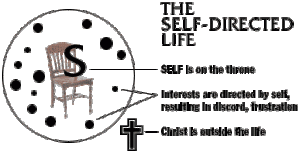


 We don’t do any good for anybody if we put on a mask and tell everyone that we’re doing great if we’re not doing great. Our trials aren’t just for us. Chances are, something we’re going through will be experienced by someone else down the road, and they will be encouraged to know that they are not alone, and that someone actually survived the trial and found themselves closer to Jesus because of it.
 And I’m trying to figure out how to find myself again.
 And at unexpected times the grief of what is left behind might crawl out of the corner in which I’ve placed it. Some days I might let it come out and sit in my lap, and I will embrace it for awhile. Then I will point it back to the corner, hoping it will stay there longer than the time before.
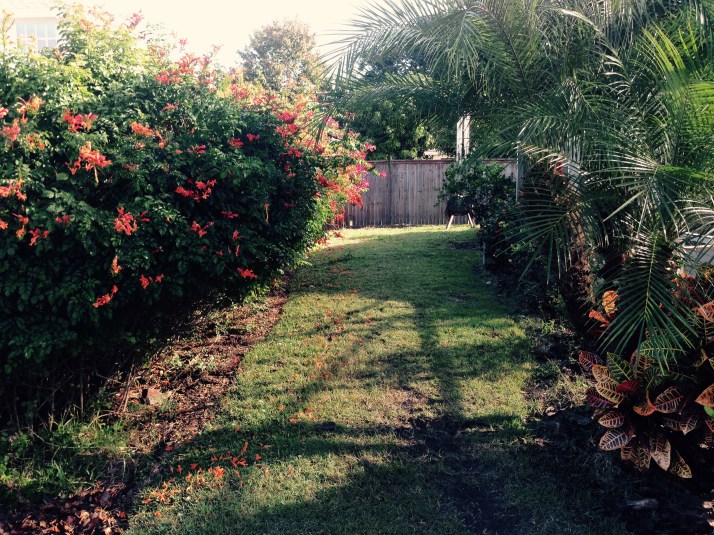 This is my backyard. Looks good, doesn’t it? If you look closely, though, you can spot the imperfections. You can see the tracks the dog has made as he madly chases his thrown ball. You can see the weeds that have gone unpulled. And if you look closer still, you can see where some plants have just not made it, despite our attention.
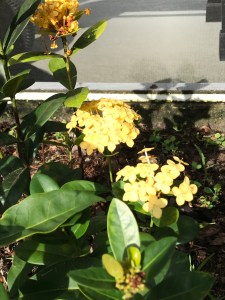 Our pulled-up Ixora is small but blossoming.
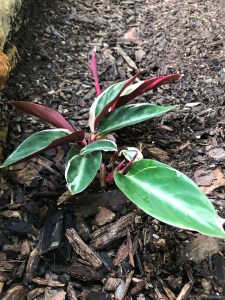 years.
 Make no mistake, we have had other plants over the years that have, simply put, died. The uprooting was complete and they never came back to life.
 Compelled